Tuesday, April 22, 2014

Introduction of Indianisation, the Early Indians and the Srivijaya empire

Indianisation 

  • term used to describe the spread of Indian cultural influence over Southeast Asia 
The period of Indianisation, which lasted from 200 B.C to the 15th century, was instrumental in binding Southeast Asia, a diverse region filled with different ethnicities, races, religions and nationalities, together. This is because under the Indian cultural influence, the various countries have created shared experiences and impacts that have resulted from Indianisation, all of which contribute to the region's common identity. An example of an impact would be the introduction of Ramayana and Mahabharata, the 2 famous Indian epics. These 2 stories are extremely widespread and popular throughout Southeast Asia. Even though the forms in which these stories are presented differ according to the country, the main story is still the same. For example, the story of Ramayana is presented in Thailand in the form of a dance called the khon. The stories are also illustrated in sculptures found in temples such as Angkor Wat in Cambodia, the Rama Temple in Malaysia, a mural painting found in Laos etc. Ramayana is also presented in Indonesia through wayang performances, the most common of which is Wayang Kulit (shadow puppetry). Based on the example presented above, it is obvious that this Indian literature epic has united Southeast Asia as it is equally popular throughout the region.

Another way that Indianisation has binded Southeast Asia together is through the concept of the mandala. Mandala is a sanskrit word that means circle. It is of Hindu origin and possesses spiritual and ritual significance for Hinduism and Buddhism. It has a very religious value in India but when it was adapted to Southeast Asia, the mandala concept took on a more political system. This is a picture of the mandala.
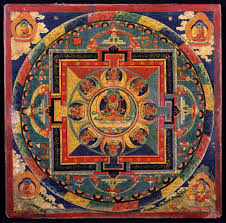


The political interpretation of mandala is called rajamandala. It describes circles of friendly and enemy states surrounding the king's state. The construction of the mandala is primarily based on 3 principles, Centre, Symmetry and Cardinal points. The concept of centre is mainly about the supposed divine ability of the king to tap into cosmic power. The Hindu devaraja and the Buddhist dharmaraja are regarded as men of prowess and represent the centre of the mandala. The concept of symmetry represents the forward and rearward friends and enemies of the country, and also signifies a balance between the east and west. The cardinal points represent the fact that the trading regimes of the mandalas required a network of intelligence that went beyond the sub-region.

The mandala was the dominant form of the Southeast Asian States until the 19th century. Therefore, Southeast Asia was bonded by the Mandala Political System, as many traditions and beliefs resulted from it, such as the belief that the king/the men of prowess had divine power and that they should be worshipped etc.

The Early Indians

Location: Various parts of India

They had trade and cultural relations with West Asia, Rome, China and Southeast Asia. The demand for Eastern goods prompted the Indians to trade along the Malay Peninsula. They were initially searching for Suvarnabhumi, the land of gold, in Thailand, but they soon found something even greater, a land which was virtually un-ventured to. This was necessary for them as they needed to expand their influence and seek new knowledge.

Srivijaya

Capital: Palembang

Location: On the island of Sumatra

It became a maritime empire which was made up of river-based coastal trading communities which were joined together. The Srivijaya people also had good relations with the agricultural hinterland, which allowed them to gain a dependable supply of commodities for trade, so the founders of Srivijaya were able to support a larger maritime trade zone and establish an empire that dominated the region from 670-1025.

Srivijaya was strategically located near the Southern entrance of the Strait of Malacca, its port had a hinterland trading system which delivered commodities for the maritime trade. The traders were made up of seamen who spent most of their lives on water, hence they had certain 'homeports' upon which their lives were dependent on. The Srivijaya port, being one of these 'homeports', provided food and boat equipment for the voyages. Eventually, Srivijaya established dominance of the coastlines and built a major coastal emporium on the southeast coast. This eliminated the competition from the rival port states, thus making it a safe passage for foreign shipping. As the port became more and more important, it gained control of the Straits of Malacca, thus all the trade between the East and West was channeled through Srivijaya, soon,  it replaced Funan as the entrepot between Chinese and Indians.

In the 9th century, there was a union formed between Srivijaya and the Buddhist Sailendra dynasty, creating an empire that dominated the region of Southeast Asia until the 14th century, a whole 500 years.

Process of Indianisation

As the entrepot of the Chinese, Indonesian and Indian markets, Srivijaya was heavily involved in the India-China shipping business, which involved ship repairs, outfitting, storage, supplies, layovers and so on. As more and more Indian merchants frequented the port, they brought their main religion at that time (6th and 7th century) Buddhism with them to Srivijaya. As a result, the port quickly became an important religious center, and so became an entrepot for the spread of religious ideas between India and China. It was a good thing for Srivijaya as well, because the rulers felt that military power and political skill was far from enough to ensure the survival of Srivijaya, which was expanding rapidly due to its military expeditions against rival ports. Srivijaya needed a belief system that could unite the conquered regions, which had different religions and ethnicities, under a common loyalty to Srivijaya's capital, Palembang. They found this in Buddhism, and thus became a stronghold of Vajrayana Buddhism.


Through the traders, a lot of India's cultures and customs were brought over to Srivijaya and Southeast Asia, their dominant religions, their folktales and even their language, Sanskrit. As a result, Srivijaya was dominantly influenced by the Indians.


There were several theories formulated regarding the process of Indianisation, namely the Kshatriya, Vaishya and Brahman hypotheses. These will be elaborated on in the next post.

Theories of Indianisation

The 3 theories of Indianisation are The Theory of the Brahmins, The Theory of the Vaisyas and The Theory of the Kshatriyas.

1. The Theory of the Brahmins 

  • Brahmins were the only caste in the Indian caste system who were allowed to become priests
  • In this theory, they were the ones responsible for the Indianisation in Southeast Asia 
The Brahmins apparently came to Southeast Asia in search of wealth, along with the explorers, traders and other religious leaders. This was because during that period, Southeast Asia was already known for its great wealth. Therefore, there was a great indian influence in Southeast Asia, as can be seen by the fact that there were many early states in Southeast Asia which had Indian priests as their rulers. They were credited for Indianisation mainly because as the number of Brahmins living in Southeast Asia grew, rulers in Southeast Asia relied on them more and they served as development planners in different fields, in law, government and art.

However, it was debunked because of the fact that Southeast Asia did not adopt the caste system, upon which the Brahmin theory was based on. If the caste system did not even exist, it was not possible for the Brahmins to have their status as a Brahmin in Southeast Asia, and thus they cannot be credited completely for the Indianisation.

2.. The Theory of the Vaisyas 

  • In this theory, Indianisation is stated to have begun with traders or merchants who spread their culture, goods and religion via trade between India and Southeast Asia

This theory came about because there was a large amount of trade between India and Southeast Asia. Along with the trade would naturally come a lot of interaction between the traders and the locals, hence it was assumed that Indian influence was spread through this manner.

However, it was debunked because merchants of low origin and caste should and would not have the knowledge to pass on ideas of extremely complex expertise. A good example would be the concepts of kingship, denominations, philosophical teachings, cosmology and so on, which are all among the influences of Indianisation. They also did not have the legitimacy to install rulers in the different states in Southeast Asia.

3. The Theory of the Kshatriyas 

  • In this theory, Indianisation is presumed to have begun due to the great influence of the Indian warriors and conquerors, who migrated to Southeast Asia and conquered the land through war 
This theory came about mainly because of the extremely prominent Indian influence in Southeast Asia. As it would be near impossible for a peaceful propagation (as suggested by the Vaisyas theory) to have such a great influence on Southeast Asia, it was assumed that the most powerful influence, which would be from military conquest and war, was what caused Indianisation. 

This theory was debunked because there was a lack of evidence provided for this hypothesis. If Southeast Asia was really colonized by the Indians, there would be very significant lasting changes in Southeast Asian culture, but as can be seen today, Southeast Asia has not adopted the Indian caste system, nor Indian dietary habits. Both politically and economically, there is no sign or evidence that Southeast Asian countries ever showed subordination to India, hence this theory of military conquests and colonisation is false. 

4. Current Theory 

Therefore, the debunking of the previous 3 theories leaves us with this last one, which is that Indianisation in Southeast Asia occurred gradually, due to cultural diffusion. The process of Indianisation was most likely the outcome of endeavors of all the 3 groups of people, the warriors, traders and priests. Although the traders had no expertise to pass on the complex ideas, however they were still important transmitters of the Indian culture. Through their interactions with the locals, their practices and religion would definitely have been spread to the Southeast Asian Region, but instead of the region absorbing everything whole-sale, the people adapted the culture, beliefs and practices according to their own needs, thus practicing syncretism. This can be seen by the fact that Southeast Asians do not practice the caste system, but Indian literature, such as Ramayana, is very popular even today and performed in all Wayang performances. Buddhism and Hinduism were also spread to Southeast Asia by the Indian traders, hence the theory of cultural diffusion and syncretism stands firm.  


Impacts of Indianisation

There was a limited quantity of objects that were actually traded between the Indians and the Southeast Asians. This was because the items which the Indians desired could be easily obtained through the routes already established by the Roman State, the Arabian and East African Ports and the other traders of the western subcontinent. The items that the Southeast Asians desired could be obtained by local manufacturing. This included beads and iron, which have been incorrectly viewed as evidence of Indian-Southeast Asian trade for a long time.

However, there was definitely evidence of a gradual widespread adoption of Indian religious and political traditions in Southeast Asia. There was architecture which was influenced by Buddhist and (later on) Hindu religious beliefs, such as the religious temples, the adoption of Sanskrit for official inscriptions, such as the name Srivijaya itself. 'Sri' means prosperous in Sanskrit and 'Vijaya' means victorious. A picture of Sanskrit inscription can be found here.

Another visible impact of Indianisation in Southeast Asia is the use of the term 'Gupta Dynasty' to mark the period of time from 400 CE to 600 CE. This term was used by all the Southeast Asians, thus showing how the people in Southeast Asia, though they were of different countries and ethnicities shared a common trait through Indianisation. The Guptas had control throughout a large part of India and retained that control for 2 centuries. India was ruled by the Gupta Dynasty, hence the changes implemented by the Gupta rulers had a great effect on India and subsequently, had a domino effect on Southeast Asia.

Some of these impacts included the revival of Sanskrit as the official language used for inscriptions, land grants, seals and coins and the shifting away from Buddhism to Hinduism. Out of these impacts, the shifting away from Buddhism to Hinduism is the most important and monumental in my opinion. This is because the change in dominant religion of India brought about the change of dominant religion in Southeast Asia. Along with Hinduism came the various Indianised empires in Southeast Asia, one of which is Srivijaya.

Another impact of Indianisation is the introduction of the 2 famous Sanskrit epics, Ramayana and Mahabharata. Ramayana was especially popular in Srivijaya, as it was the fountain source of a great tradition of culture, language and religion. Indonesian versions of Ramayana was created and it was called Kahawin Ramayana. This version of Ramayana was a good example of how Indian traditions and culture were assimilated into the original beliefs in Southeast Asia. It showed syncretism because Javanese beliefs were mixed into the original story of Ramayana, such as the inclusion of the all powerful Javanese indigenous deity Dhayana. This Indonesian version was performed in all Wayang performances. In Srivijaya, Wayang Kulit and Wayang Wong performances were normally held. Wayang Kulit is a form of shadow puppetry, where shadow puppets are made with fine tools and are supported with buffalo horn handles and control rods. Wayang Wong, on the other hand, was a type of theatre performance, with the use of masks dependent on the storyline. A video of this can be found here

Indianisation also influenced the art pieces, sculptures and architecture produced during that time. The art pieces were mostly influenced by the dominant religion of Srivijaya at that time, which was of course influenced by India. An example would be the gold coated bronze statue of 4 handed Avalokitecyara in Srivijayan style. This Srivijayan style/art was inspired by both Indian Amaravati style and Javanese Sailendra art. The picture of this statue can be found here Religious architecture is also found in Srivijaya, the remnants of the dominant religions, Hinduism and Buddhism. This is especially evident in a very famous temple, Borobudur. This temple is in a 3 dimensional form of a mandala and it was designed during the reign of the Sailendra Dynasty, which Srivijaya ruled with Sailendra. This design blends the Indonesian cult of ancestor worship and the Buddhist concept of attaining Nirvana. It also demonstrates the influences of Gupta art and thus India's influence on Southeast Asia. There is syncretism in the design of the temple as it incorporates both Indian and Indonesian elements. The picture of this temple can be found here. An inscription that is found at the temple also provides a description of how Srivijayan vessels looked like. It can be found here. This shows a possible link between religion and trade, where vessels are most commonly used for, hence supporting the theory that trade was an important cause for the spread of Indian ideas, especially religious ideas.


Conclusion

To end off, here is a summary of the tale of Indanisation in Srivijaya. Thank you for taking part in this interactive tour and I hope that you have SEA-n the light and gained new understanding of the process and impacts of Indanisation on Southeast Asia, and on Srivijaya especially.

Have a great SEA-filled day ahead! (:

Signing off,
Anna Cheang (6)
307


References

1. Southeast Asian Riverine and Island Empires. n.d. [online] Available at: .

2. The Srivijaya Empire. 2014. [online] Donlehmanjr.com. Available at: [Accessed 21 Apr. 2014].

3. Mahulikar, G., n.d. EFFECT OF RAMAYANA ON VARIOUS CULTURES AND CIVILISATIONS  

4. Hindu Wisdom - Glimpses XV. 2014. [online] Hinduwisdom.info. Available at: [Accessed 21 Apr. 2014].

5. Lukas, H., 2014. Theories of Indianisation. 1st ed. Vienna.

6. Smith, M., n.d. Indianization from the Indian Point of View. 1st ed. BRILL 

Picture and Video References: 
1. http://www.eighteggs.com/sac/uploads/userfiles/hos_3.jpg  
2. www.youtube.com/watch?v=oLucjPONL0E

3. en.wikipedia.org/wiki/Srivijaya 
4. https://encrypted-tbn1.gstatic.com/images?q=tbn:ANd9GcSUNRWWuqpM4Sut1yMiqPzJp2f1pzIyUMAIY_gVVu5ihkI6jvxq
5. http://www.borobudurpark.com/AppManual/inti/content/manualimageimage/borobudur_aerial.jpg