- term used to describe the spread of Indian cultural influence over Southeast Asia
The period of Indianisation, which lasted from 200 B.C to the 15th century, was instrumental in binding Southeast Asia, a diverse region filled with different ethnicities, races, religions and nationalities, together. This is because under the Indian cultural influence, the various countries have created shared experiences and impacts that have resulted from Indianisation, all of which contribute to the region's common identity. An example of an impact would be the introduction of Ramayana and Mahabharata, the 2 famous Indian epics. These 2 stories are extremely widespread and popular throughout Southeast Asia. Even though the forms in which these stories are presented differ according to the country, the main story is still the same. For example, the story of Ramayana is presented in Thailand in the form of a dance called the khon. The stories are also illustrated in sculptures found in temples such as Angkor Wat in Cambodia, the Rama Temple in Malaysia, a mural painting found in Laos etc. Ramayana is also presented in Indonesia through wayang performances, the most common of which is Wayang Kulit (shadow puppetry). Based on the example presented above, it is obvious that this Indian literature epic has united Southeast Asia as it is equally popular throughout the region.
Another way that Indianisation has binded Southeast Asia together is through the concept of the mandala. Mandala is a sanskrit word that means circle. It is of Hindu origin and possesses spiritual and ritual significance for Hinduism and Buddhism. It has a very religious value in India but when it was adapted to Southeast Asia, the mandala concept took on a more political system. This is a picture of the mandala.
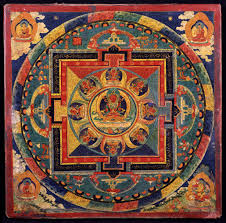
The political interpretation of mandala is called rajamandala. It describes circles of friendly and enemy states surrounding the king's state. The construction of the mandala is primarily based on 3 principles, Centre, Symmetry and Cardinal points. The concept of centre is mainly about the supposed divine ability of the king to tap into cosmic power. The Hindu devaraja and the Buddhist dharmaraja are regarded as men of prowess and represent the centre of the mandala. The concept of symmetry represents the forward and rearward friends and enemies of the country, and also signifies a balance between the east and west. The cardinal points represent the fact that the trading regimes of the mandalas required a network of intelligence that went beyond the sub-region.
The mandala was the dominant form of the Southeast Asian States until the 19th century. Therefore, Southeast Asia was bonded by the Mandala Political System, as many traditions and beliefs resulted from it, such as the belief that the king/the men of prowess had divine power and that they should be worshipped etc.
The Early IndiansAnother way that Indianisation has binded Southeast Asia together is through the concept of the mandala. Mandala is a sanskrit word that means circle. It is of Hindu origin and possesses spiritual and ritual significance for Hinduism and Buddhism. It has a very religious value in India but when it was adapted to Southeast Asia, the mandala concept took on a more political system. This is a picture of the mandala.
The political interpretation of mandala is called rajamandala. It describes circles of friendly and enemy states surrounding the king's state. The construction of the mandala is primarily based on 3 principles, Centre, Symmetry and Cardinal points. The concept of centre is mainly about the supposed divine ability of the king to tap into cosmic power. The Hindu devaraja and the Buddhist dharmaraja are regarded as men of prowess and represent the centre of the mandala. The concept of symmetry represents the forward and rearward friends and enemies of the country, and also signifies a balance between the east and west. The cardinal points represent the fact that the trading regimes of the mandalas required a network of intelligence that went beyond the sub-region.
The mandala was the dominant form of the Southeast Asian States until the 19th century. Therefore, Southeast Asia was bonded by the Mandala Political System, as many traditions and beliefs resulted from it, such as the belief that the king/the men of prowess had divine power and that they should be worshipped etc.
Location: Various parts of India
They had trade and cultural relations with West Asia, Rome, China and Southeast Asia. The demand for Eastern goods prompted the Indians to trade along the Malay Peninsula. They were initially searching for Suvarnabhumi, the land of gold, in Thailand, but they soon found something even greater, a land which was virtually un-ventured to. This was necessary for them as they needed to expand their influence and seek new knowledge.
Srivijaya
Capital: Palembang
Location: On the island of Sumatra
It became a maritime empire which was made up of river-based coastal trading communities which were joined together. The Srivijaya people also had good relations with the agricultural hinterland, which allowed them to gain a dependable supply of commodities for trade, so the founders of Srivijaya were able to support a larger maritime trade zone and establish an empire that dominated the region from 670-1025.
Srivijaya was strategically located near the Southern entrance of the Strait of Malacca, its port had a hinterland trading system which delivered commodities for the maritime trade. The traders were made up of seamen who spent most of their lives on water, hence they had certain 'homeports' upon which their lives were dependent on. The Srivijaya port, being one of these 'homeports', provided food and boat equipment for the voyages. Eventually, Srivijaya established dominance of the coastlines and built a major coastal emporium on the southeast coast. This eliminated the competition from the rival port states, thus making it a safe passage for foreign shipping. As the port became more and more important, it gained control of the Straits of Malacca, thus all the trade between the East and West was channeled through Srivijaya, soon, it replaced Funan as the entrepot between Chinese and Indians.
In the 9th century, there was a union formed between Srivijaya and the Buddhist Sailendra dynasty, creating an empire that dominated the region of Southeast Asia until the 14th century, a whole 500 years.

No comments:
Post a Comment